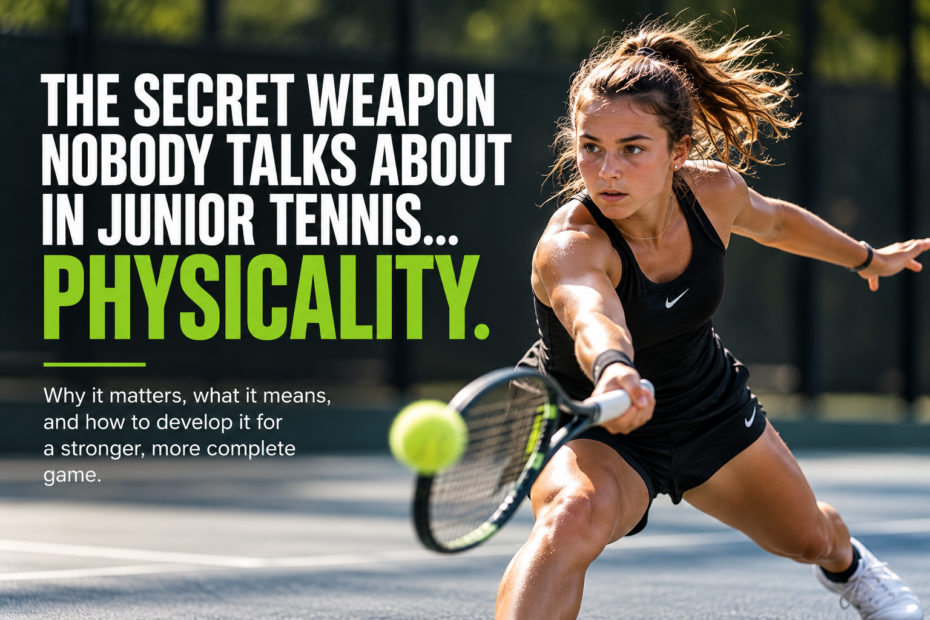
Spend enough time around high-level tennis and you begin to notice something that has very little to do with forehands, backhands, or serves.
Over the past several weeks, I’ve had the opportunity to watch NCAA Division I women’s tennis up close, not from the stands, but courtside during practices and matches.
One thing quickly became obvious…
The difference between good players and great players isn’t simply better strokes.
It isn’t always a bigger serve.
It isn’t always more winners.
It’s physicality.
You can feel it when one player imposes herself on a match. You can also see when another player struggles to match that physical presence. Interestingly, even at the Division I level, physicality isn’t constant. Some matches a player brings all of it. Other matches she doesn’t. And when one player or team consistently demonstrates more physicality across the entire match, the difference often shows up on the scoreboard.
That’s what got me thinking.
Physicality may be one of the most overlooked skills in junior tennis.
What Does Physicality Really Mean?
Ask most players or parents what “physicality” means and you’ll probably hear words like:
- Strength
- Power
- Speed
- Bigger muscles
- Harder serves
Those certainly play a role, but I don’t think they tell the whole story.
Here’s the definition I’ve started using:
Physicality is the ability to consistently impose your body on the match while preventing your opponent from imposing theirs on you.
Notice what isn’t in that definition.
Nothing says you have to hit the ball harder.
Instead, physical players:
- Stay balanced under pressure.
- Recover quickly after every shot.
- Absorb pace instead of fighting it.
- Control court position.
- Create pressure with movement and ball quality.
- Continue doing it for two or three hours if necessary.
In other words, they make the court feel smaller for themselves and larger for their opponent.
Physicality Is More Than Strength
One of the biggest misconceptions in tennis is that the strongest player is automatically the most physical player.
That’s simply not true.
Some players weighing 120 pounds feel incredibly physical.
Others who are bigger and stronger don’t.
Why?
Because physicality isn’t just about how much force you can create.
It’s about how efficiently you organize and apply your body throughout every point.
The more I think about it, the more I believe physicality can be broken into five dimensions.
The Five Dimensions of Tennis Physicality
1. Movement Physicality
Everything begins here.
Can you own your position?
Can you stay balanced while changing direction?
Can you absorb force before producing force?
Can you recover efficiently for the next shot?
This is one of the reasons I developed the Tennis Fix Force Management™ system. Better movement isn’t simply about getting faster. It’s about becoming more physical through better organization.
Players who move well often appear faster without actually running faster.
2. Ball Physicality
A physical player doesn’t necessarily hit the hardest ball.
They hit a ball that creates problems.
Depth.
Spin.
Margin.
Consistency.
A heavy ball forces opponents into uncomfortable positions, making them defend instead of attack.
The question isn’t, “How hard can you hit?”
The better question is, “Can your opponent feel your ball?”
3. Positional Physicality
Physical players control space.
They own the middle of the court.
They recover early.
They take time away from opponents.
They force opponents into defensive positions while creating offensive opportunities for themselves.
Watch high-level tennis and you’ll notice that many points are won before the final shot simply because one player consistently owns better court position.
4. Competitive Physicality
Physicality isn’t something you demonstrate for three games.
It’s something you sustain for an entire match.
Can you continue moving aggressively at 5-5 in the third set?
Can you keep applying pressure when you’re tired?
Can you recover between long rallies and do it again?
Competitive physicality is about maintaining your level when fatigue begins affecting everyone else.
5. Mental Physicality
This dimension may be the hardest to measure.
Body language.
Intent.
Resilience.
Purpose.
Physical players often project confidence because they continue imposing themselves regardless of the score.
They don’t disappear after losing a long rally.
They regroup.
Recover.
Compete.
And make their opponent earn the next point.
Why This Matters for Junior Players
Parents spend thousands of dollars on lessons focused on strokes.
Players hit hundreds of forehands every week.
They practice serves.
Backhands.
Volleys.
But how often do they intentionally train physicality?
How often do they work on:
- Balance
- Recovery
- Movement efficiency
- Force absorption
- Court positioning
- Sustaining physical pressure
These skills often separate players far more than another basket of forehands.
Becoming More Physical
Physicality isn’t something you’re born with.
It’s something you develop.
Movement training.
Strength training.
Recovery.
Competitive habits.
Purposeful practice.
All contribute to becoming a more physical player.
That’s why movement training has become such an important part of my coaching philosophy. Force Management™ isn’t simply about moving better. It’s about developing one dimension of physicality that supports every stroke, every rally, and every match.
The goal isn’t to become the strongest player on the court.
The goal is to become the player who uses their body most effectively.
The Next Time You Watch Tennis…
Don’t just watch the ball.
Watch who stays balanced.
Watch who recovers first.
Watch who controls the middle.
Watch who keeps applying pressure point after point.
Watch who still moves with purpose late in the match.
That’s physicality.
And it may be the secret weapon nobody talks about in junior tennis.
Common Questions We Get Asked About Physicality in Tennis
Q. What does physicality mean in tennis?
A. Physicality in tennis is the ability to consistently use your body to control movement, maintain balance, recover efficiently, create pressure, and compete with purpose throughout a match. It involves much more than strength or power.
Q. Why is physicality important in tennis?
A. Physicality helps players stay balanced, recover faster, maintain better court position, and continue applying pressure throughout a match. Players with greater physicality often perform more consistently under pressure and fatigue.
Q. Can movement training make you more physical?
A. Yes. Improving movement, balance, force absorption, recovery, and body organization helps players become more physical on the court without necessarily becoming stronger or faster.
Q. What is Force Management™ in tennis?
A. Force Management™ is a movement system that teaches players to establish a stable base, organize their center of mass, absorb force, produce force efficiently, and recover for the next shot. These principles help players move more efficiently and build greater physicality on the court.
Q. How do college tennis players become more physical?
A. College players develop physicality through movement training, strength and conditioning, efficient recovery, competitive match play, and learning to consistently apply pressure across every point. The players who consistently demonstrate all five dimensions of physicality often separate themselves over the course of a match.
Want to Become a More Physical Tennis Player?
Physicality isn’t developed by accident.
It comes from intentional movement training, purposeful practice, and understanding how your body creates, absorbs, and redirects force on the court.
At Tennis Fix, that’s exactly what we teach.
Whether you’re a junior player looking to improve your movement, a high school athlete preparing for the next level, or a competitive adult who wants to move more efficiently, our Force Management™ Performance Lab is designed to help you build the movement foundation that supports every shot.
Learn more about Tennis Fix Force Management™ Performance Lab and upcoming sessions.
Coming Next…
The Five Dimensions of Tennis Physicality
- Part 1: Movement Physicality — Why Better Movers Win More Matches
- Part 2: Ball Physicality — What Makes a Ball Feel “Heavy”?
- Part 3: Positional Physicality — Own the Middle, Own the Match
- Part 4: Competitive Physicality — Why the Third Set Is Different
- Part 5: Mental Physicality — The Body Language of Winners